
The next morning, Lucy’s desperation took the form of a cold, metallic tape measure. Emma watched in silent curiosity from the tangle of her bedsheets as her mother stretched the metal strip from corner to corner, her lips moving in a frantic cadence of whispered numbers. Lucy measured the nursery, then the cramped hallway, then the guest room on the opposite side, scrawling figures onto the back of a discarded envelope with trembling precision.
When she finally laid her rough, hand-drawn sketch over the glossy, photocopied floor plan from the estate agent, the discrepancy hit her like a physical blow. It was small—barely a few hand spans—but mathematically undeniable. The guest room was shallower than the dimensions of the house allowed. It was a subtle theft of space, just enough to be overlooked by a casual eye, but plenty to conceal a hollow void—a secret chamber sandwiched between two seemingly ordinary rooms.
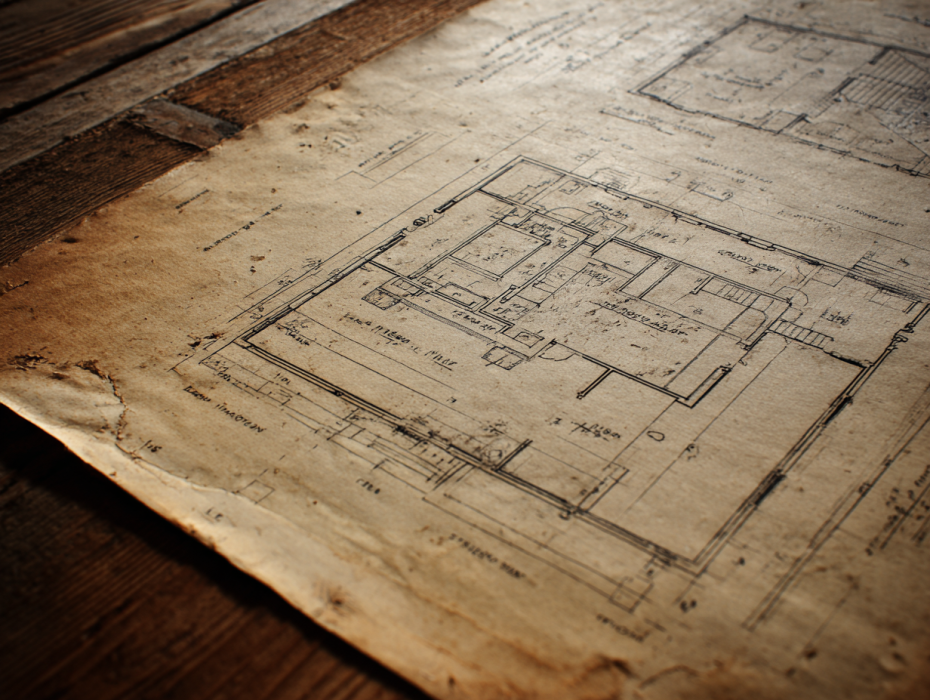
That afternoon, Lucy retrieved the original blueprints from the back of a deep cupboard. They were rolled into a brittle, skeletal tube, the paper so yellowed and delicate it felt like it might dissolve under her touch. As she unrolled them, she realized the layout was a ghost of its current self: a former storeroom where the guest room now sat, a narrower landing, and none of the modern fitted wardrobes. But between Emma’s room and the adjacent space, a sharp, hand-inked rectangle caught her eye. It had been drawn with deliberate precision, only to be later struck through with a heavy, aggressive “X”.
In the margin, a handwritten scrawl clung to the edge of the page, the ink faded to a ghostly brown. Only the year 1946 stood out with any clarity. The rest of the words were a blurred map of forgotten intentions, eroded by time and damp. Lucy traced the inked lines with a trembling finger, overcome by a sudden, nauseating disorientation. The house she inhabited, the walls she cleaned and the floors she walked, was a lie—a modern mask stretched over a different, older structure that had been redacted from history.

That evening, Lucy brought her findings to her video session, holding the yellowed envelope up to the webcam like a piece of incriminating evidence. “So, there is a cavity. A real one,” she said, her voice tight with a mixture of triumph and exhaustion. “An old storeroom, perhaps, or a forgotten closet. I’m not imagining the discrepancies; they are inked into the history of the house.” Saying it out loud made her feel both vindicated and faintly ridiculous—as if she were a character in a gothic novel rather than a mother in a modern suburb.
The therapist nodded, her expression shifting to one of measured contemplation. “It sounds like you’ve uncovered a tangible fact,” she said softly. “In a way, that should make you feel safer. It proves your senses aren’t failing you; it simply means the house possesses a spatial history you weren’t privy to. It’s natural to feel unsettled when the walls aren’t where they should be. Perhaps the next step is a professional structural survey? Let someone else carry the weight of the mystery for a while.” The advice acted as a temporary anchor for Lucy, though the unease continued to pulse beneath the surface, cold and persistent.

The following week, she booked an inspection with a contractor named Harris, a man who specialized in the idiosyncrasies of older properties. On the morning of his arrival, Emma set off for school, her small hand clutching the straps of her backpack, blissfully unaware of the quiet tremor of anticipation vibrating through the house behind her. Lucy watched her daughter disappear down the street, then turned back to the wall, acutely aware that by sunset, her suspicion might finally solidify into cold, hard reality.
Harris was a broad-shouldered man with a slow, methodical gait. He walked the length of Emma’s room, his knuckles performing a rhythmic, percussive dance against the plaster. “There’s definitely a void here,” he concluded, his voice echoing slightly in the sparsely furnished space. “Could be a redundant chimney breast, or perhaps a boxed-in linen cupboard from the turn of the century. Nothing structurally threatening, from the sound of it. These old builds are honeycombed with surprises.”

He ran a handheld sensor along the plaster, his eyes narrowed as he tracked the fluctuating readings on the small digital display. “There’s a significant gap here, about a metre deep,” he murmured, more to himself than to her. “Maybe more. No metal readings, though—no pipes, no wiring. Just ancient timber and dead air.” He straightened his back, the scratch of his pen against the clipboard sounding unnervingly loud in the quiet room. “If you want it open, we can perform a careful exploratory cut. Just to see what we’re dealing with.”
Lucy hesitated, her breath hitching. A primal part of her wanted to scream yes—to rip the uncertainty away with the plaster and expose the house’s secrets to the light of day. But another part of her recoiled. She looked at Emma’s neatly made bed, the pale sunlight on the pillows, and baulked at the thought of this sanctuary being transformed into a chaotic building site. She could already see the fine grey dust settling into the sheets and hear the intrusive roar of machinery in the one place her daughter still slept in peace.
“Let me sit with it for a day or two. I’ll get back to you,” she said, her voice sounding hollow even to her own ears.

The therapist listened in a profound silence before finally responding. “It sounds as though you’ve uncovered a piece of history that was literally walled in,” she said, her voice carrying a weight of understanding. “No wonder it felt so oppressive. Sometimes our bodies notice what our minds aren’t yet equipped to understand. You weren’t losing your grip, Lucy; you were reacting to a tangible anomaly—you just didn’t know its shape until now.”
That night, Lucy chose to sleep on the sofa downstairs, leaving the mystery of the second floor behind her. The house creaked and settled in its familiar, rhythmic ways, but the quality of the sound had changed. She listened intently for the tapping, but the wall remained utterly silent, as if being “found” had finally satisfied whatever echo lived within the plaster. There was only the low, melodic sigh of the wind in the chimney, and beneath it, a quiet that felt, for the first time in months, like pure, unadulterated relief.
Top Articles